
Discover excellent elementary science fair ideas kids will love. Easy project questions by category, plus a free printable to help you get started.
That flyer came home in your kid’s backpack, didn’t it? The one about the science fair. And now you’re hunting for elementary science fair projects that won’t require a PhD or a nervous breakdown.
Deep breath. We’ve got you.
The best science fair projects for elementary kids are surprisingly simple – and way more fun when your child does most of the work themselves.
Below, you’ll find over 50 science experiments for elementary students that use stuff you probably already have, won’t take a month to complete, and might actually get your K-5 kid excited about learning.
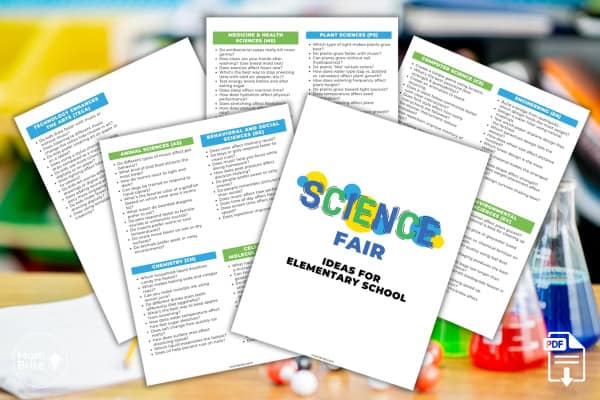
Oh, and there’s a free printable at the end with all these ideas organized by category. You’re welcome.
What Makes a Great Elementary Science Fair Project?
Not all science fair projects are created equal. Here’s what separates the “my kid actually learned something” projects from the “we all cried at 10 pm” disasters:
- They ask a simple question. “Does a plant grow better in sunlight or shade?” is perfect. “What is the effect of various electromagnetic frequencies on plant cellular mitosis?” is not.
- Kids can do most of the work. If you’re doing 90% of the project, it’s your project, not theirs. (We know it’s tempting.)
- The results are visible. Young kids need to SEE something happen. Color changes, growth, movement, bubbles – that’s the good stuff.
- It connects to their world. Projects about candy, pets, or playground equipment? Instant engagement.
New to the scientific method? Our scientific method for kids worksheets break it down into easy steps your child can follow.
Choosing Science Projects by Grade Level
Not every project works for every age. Here’s a quick guide to help you match the project to your child’s grade:
Kindergarten and 1st Grade
At this age, keep it simple and visual. Kids this young are still building observation skills, so the best projects have clear, obvious results they can see and describe.
Good fits: Sink or float experiments, growing beans in a bag, color mixing, magnet exploration, and simple “which dissolves faster” tests with candy or sugar cubes.
Keep in mind: Projects should take just a few days (not weeks), and kids will need help writing and organizing their findings – but the observations and ideas should come from them.
2nd and 3rd Grade
Now kids can handle projects that take a bit longer and involve comparing two or three things. They’re ready to make simple predictions and start understanding cause and effect.
Good fits: Plant growth experiments (light vs. dark, different liquids), testing paper airplane designs, building simple bridges or towers, bread mold experiments, and animal behavior observations.
Keep in mind: Kids can write their own observations with some spelling help. Encourage them to make a prediction before starting and explain whether they were right or wrong.
4th Grade
Fourth graders can take on more independent projects with multiple steps. They’re ready to collect data, make charts, and explain the science behind their results.
Good fits: Testing variables (ramp angles, battery types, soil types), behavioral science surveys, crystal growing, simple circuits, erosion experiments, and projects that require measuring and recording data over time.
Keep in mind: At this level, kids should be able to explain why something happened, not just what happened. Encourage them to research the science concept behind their project.
5th Grade
Fifth graders are ready for more complex experiments with controlled variables. They can design their own procedures, analyze results, and draw conclusions based on evidence.
Good fits: Testing water filtration methods, comparing insulation materials, chemical reaction experiments (pH indicators, oxidation), renewable energy projects (solar ovens, wind turbines), and multi-week observations like composting or water quality testing.
Keep in mind: Fifth graders can handle projects that require more research and longer timelines. Encourage them to identify what they would do differently next time – that kind of reflection shows real scientific thinking.
Elementary Science Fair Project Ideas by Category
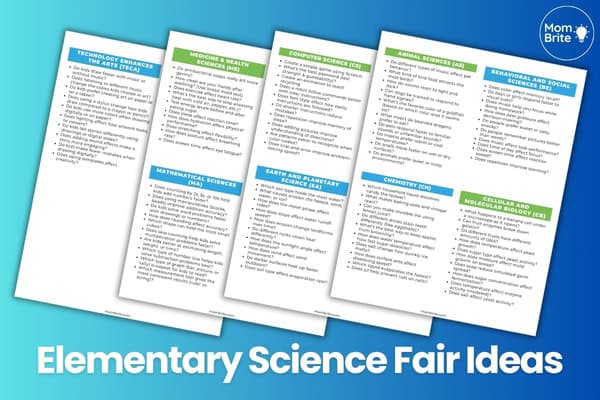
We’ve sorted these by science category so you can match the project to your kid. Got an animal lover? Head to Animal Sciences. A future engineer who takes apart everything? Physics and Engineering awaits. A kid who just wants to make something bubble or explode? Chemistry.
Plant Sciences
Plant experiments are great for younger kids because the results are visual and they’re pretty hard to mess up. Plus, there’s something satisfying about watching a bean actually sprout.
- Which type of light makes plants grow best? Test sunlight vs. artificial light vs. darkness.
- Do plants grow faster with music? Play different genres and measure growth over 2-3 weeks.
- Can plants grow without soil? Try a simple hydroponics setup with bean seeds.
- How does water type affect plant growth? Compare tap water, bottled water, and rainwater.
- Do plants “like” certain colors? Cover plants with different colored cellophane and observe.
Chemistry
Chemistry projects are crowd-pleasers because they often involve reactions kids can see (and sometimes hear). Just be ready for the “Can we do it again?” requests.
- Which liquid dissolves candy the fastest? Test water, vinegar, soda, and milk with gummy bears or hard candies.
- What makes baking soda and vinegar react? Experiment with different amounts and temperatures.
- Can you make invisible ink with lemon juice? Write a message and reveal it with heat.
- Do different drinks stain teeth differently? Use eggshells as a stand-in for tooth enamel.
- What’s the best way to keep apples from browning? Test lemon juice, salt water, plastic wrap, and more.
Physics and Engineering
If your kid loves to build, tinker, or take things apart, these projects are for them. They get to see physics in action, without needing to know the word “physics.”
- How does the angle of a ramp affect how far a car rolls? Use toy cars and books to test different slopes.
- Which bridge design holds the most weight? Build bridges from toothpicks or popsicle sticks and test them.
- Can you make a balloon-powered car? Design and race simple balloon cars.
- Which paper airplane design flies the farthest? Test different folds and measure distances.
- Do heavier objects fall faster than lighter ones? Drop different objects and time their falls. (Spoiler: Galileo already figured this out.)
- Build and test a simple catapult. Which arm length launches objects the farthest?
Earth and Environmental Science
These projects help kids understand the world around them – from the soil in their backyard to weather patterns in the sky.
- Which soil type holds the most water? Compare sand, clay, and potting soil.
- How do crystals grow? Make crystal gardens with salt, sugar, or borax.
- Can you model a volcano eruption? A classic for a reason – kids never get tired of this one.
- What causes erosion faster: wind, water, or ice? Set up mini experiments to observe each.
- Does pollution affect plant growth? Water plants with clean water vs. soapy water.
- Make a simple weather station. Track temperature, wind direction, and rainfall for a week.
Animal Sciences
Got a pet? Perfect. Don’t have one? Birds, bugs, and worms work great too. These projects let kids observe animal behavior up close.
- Do different types of music affect pet behavior? Play classical, rock, and silence for your dog or cat.
- What kind of bird food attracts the most birds? Set up feeders and keep a tally.
- How do worms react to light and dark? Observe earthworm behavior in different conditions.
- Can dogs be trained to respond to hand signals? Test whether visual cues work better than verbal ones.
- What’s a goldfish’s favorite color? See which color area of the tank the fish spends the most time in.
Behavioral and Social Science
These experiments turn the lens on people, which kids find endlessly fascinating. Plus, they can recruit family and friends as test subjects.
- Does color affect memory? Show people lists of words in different colors and test recall.
- Do boys or girls respond faster to visual cues? Use a simple reaction time test.
- Does music help you focus while doing homework? Test math problems with and without background music.
- How does peer pressure affect decision-making? Give people choices with and without group influence.
- Do people prefer sweet or salty snacks? Conduct a taste test survey.
Health and Medicine
Germ experiments are always a hit. There’s something deeply satisfying about making invisible things visible. These projects connect science to everyday hygiene habits.
- Do antibacterial soaps really kill more germs? Compare different hand soaps using bread mold.
- How clean are your hands after washing? Touch bread slices before and after washing to see mold growth.
- Does exercise affect heart rate? Measure resting heart rate vs. after jumping jacks.
- What’s the best way to stop sneezing? Test methods like cold air, pepper exposure, and pinching your nose (safely).
- Does sugar affect reaction time? Test reflexes before and after eating sugary snacks.
5 More Fan-Favorite Project Ideas
These didn’t fit neatly into the printable categories, but they’re crowd-pleasers worth mentioning:
- Egg drop challenge. Design a container that protects an egg from a high fall. This one never gets old—especially when things go splat.
- Make a lava lamp. Use oil, water, food coloring, and fizzy tablets to create a mesmerizing display while learning about density.
- Static electricity experiments. Can a balloon pick up cereal? Can you make your hair stand up? Kids love the surprising results.
- Make slime and test its properties. Vary the recipe to see how ingredients affect stretchiness and texture. (Yes, you can justify slime as science.)
- Build a simple circuit. Use a battery, a wire, and an LED to learn about electricity. Add a switch for extra credit.
Tips for Supporting Your Child’s Science Fair Project
Project picked? Great. Here’s how to support your child without taking over:
Help them plan ahead. Mold experiments and plant growth take weeks. A vinegar volcano takes 20 minutes. Help your child understand the timeline before they commit.
Let your kid lead. Yes, you could make the poster look prettier. But this is their project. Let them do the work, even when it’s hard to watch. Bonus: judges can absolutely tell when a grown-up took over.
Encourage documentation. Remind your child to take photos and write down what they observe. It makes creating the display board so much easier later.
Let them practice explaining it. If your child needs to present to judges, have them practice a few times at home. You, grandma, or even a stuffed animal make excellent practice audiences.
Embrace the mess-ups. Plants die. Mold doesn’t grow. The volcano fizzles. That’s not failure – that’s science. Write it up, explain what happened, and call it a learning experience.
Want to Skip the Supply Run Altogether?
If science fair season has you running to three different stores trying to track down supplies, I want to tell you about something that made our lives a lot easier. MEL Science sends monthly experiment kits right to your door, with everything your kid needs already in the box, from the materials to the step-by-step instructions.
We tried both their STEM kit and their physics kit, and I was honestly impressed by how well everything was put together. My kids were hooked. It won’t replace the science fair project itself, but it will keep the science momentum going after the fair is over. You can read our full MEL Science review to see exactly what arrived at our door.
Grab the Free Science Fair Project Ideas Printable
Choosing a science fair project can feel overwhelming, especially when kids like all the ideas or can’t decide where to start. To make things easier, I created a free Science Fair Project Ideas printable you can use to brainstorm, narrow down options, and get organized.
One thing to know: The categories on our printable follow AzSEF (Arizona Science and Engineering Fair) guidelines. If you’re participating in a different regional or school fair, your categories might be named differently. No big deal – the project ideas work everywhere. Just match them up with whatever categories your fair uses.
Spread it out on the kitchen table, hand your kid a highlighter, and let them go wild circling everything that sounds interesting. Narrowing it down is half the battle.
You’ve Got This
Look, science fair projects can feel like a big deal. But here’s a secret: the goal isn’t perfection. It’s watching your kid figure something out on their own, even if that “something” is just “vinegar and baking soda make a really cool fizz.”
Pick a project that sounds fun (not impressive, FUN). Grab your supplies. Let your kid take the lead. And when things get a little chaotic? That’s usually when the real learning happens.
Now go make something fizz, grow, or explode. (Safely. We mean safely.)
Happy experimenting!