
Find out what an underwater volcano eruption may look like through this fun, hands-on experiment! It’s a really cool science activity for kids to discover what happens when you mix warm and cold water while learning about volcanoes at the same time.
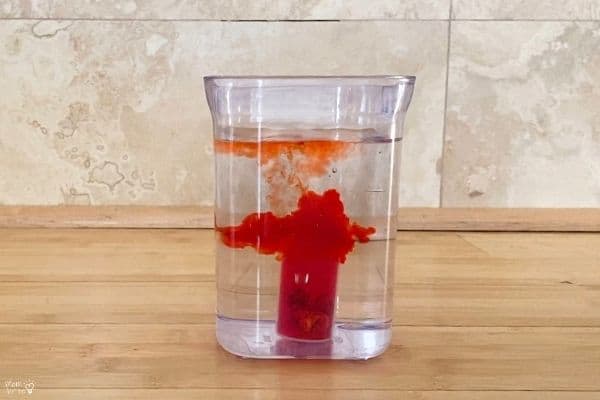
The paper mache volcano is a classic science experiment your kid might do at school. We made our own variations and erupted the LEGO volcano and apple volcano. But volcanoes don’t just exist above sea level.
With this underwater volcano experiment, we explore what it may look like when volcanoes erupt underwater. To do so, we use the concept of “warm air rises, cold air sinks” that we learned in the tornado formation experiment.
Underwater Volcano Eruption Experiment
Materials:
- Large clear container
- Small clear container (must fit inside the large one!)
- A heavy object that will weigh down the smaller container (we used small rocks)
- Water
- Red food coloring
Instructions:
1. Fill the large container with cold water.
2. Carefully place the rock(s) in the small container.
3. Add a couple of drops of food coloring in the small container.
4. Fill the small container with hot water. Since the water is hot, the food coloring should spread out and mix on its own without you stirring. But if you are finding the food coloring not mixing in the hot water, feel free to stir with a chopstick.
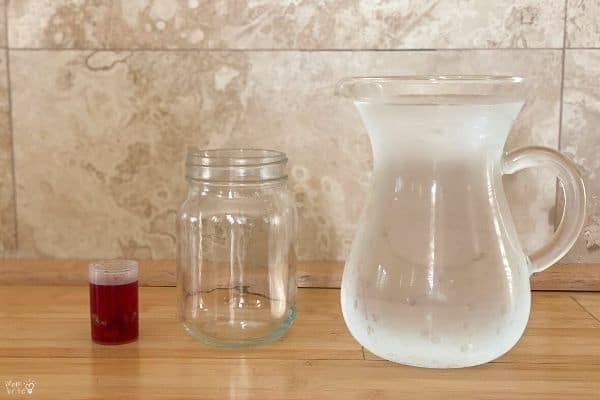
5. While keeping the container upright, gently release the small container in the large container. Tip: We actually practiced this a few times with just room-temperature water before attempting the experiment.
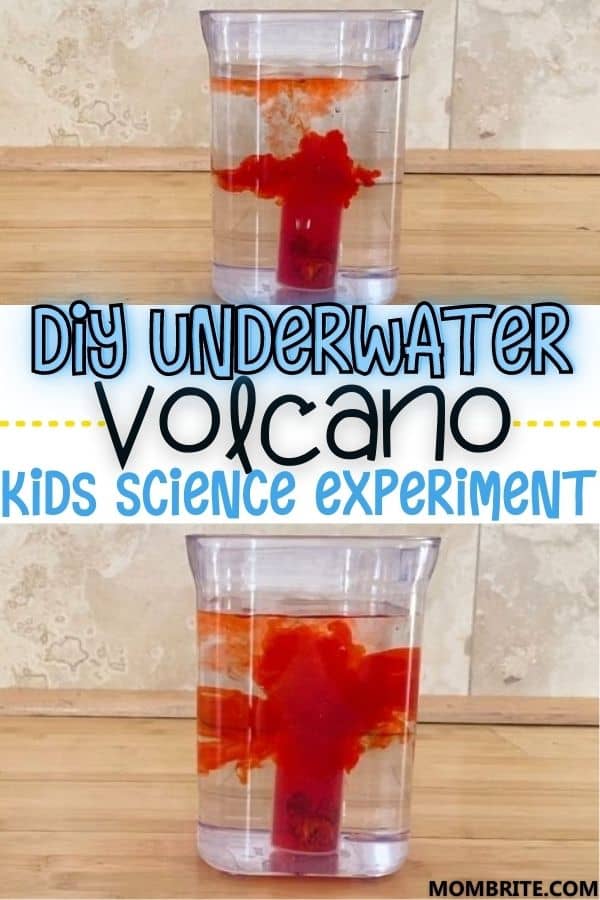
6. Watch the colored water erupt from the small container like a volcano!
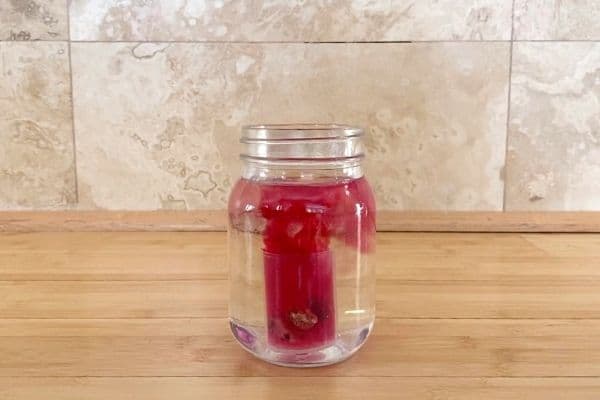
A taller container would have made the volcano eruption more dramatic, but the mason jar was the tallest container we had in the house. So if you have a tall container in the house, go for it!
The Science Behind the Underwater Volcano
Just as we learned in the “Warm Air Rises and Cold Air Sinks” experiment, hot water is less dense than cold water. As a result, the warmer water rises to the top, and the cold water sinks to the bottom.
When the water is hot, its molecules are excited and move faster. When they bump into each other, they bounce further away. Just think of a game of pool, and the break makes all the balls bounce around the pool table all over the place as they bump into each other. As the molecules spread out and increase the space between them, the density decreases.
When you drop the small container of hot water into cold water, the hot water rises above the cold water. Since we placed a rock to weigh down the small container, the hot water shoots up, looking like a volcano erupting.
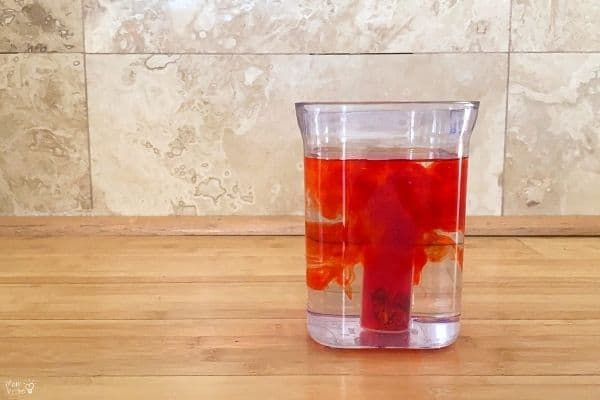
The kids had so much fun watching the undersea volcano erupt and all the “lava” flow out into the cold water. In case you never seen a real-life undersea volcano eruption before, here is a cool video to go with this experiment:
Troubleshooting the Underwater Volcano Experiment
If the hot red water mixes right away instead of rising like a volcano, don’t worry – this is a super common hiccup. The experiment is very sensitive to movement and temperature differences. Try these simple fixes to get that dramatic underwater “eruption” effect.
1. Use a Narrow Container for the Hot Water
If the red water is released too quickly, it will mix rather than rise.
Use a small bottle, jar, or cup with a narrow opening rather than a wide cup. This lets the hot water escape slowly, forming a visible plume instead of dumping all at once.
2. Increase the Temperature Difference
The volcano effect works because hot water is less dense than cold water and wants to rise. If the “hot” water isn’t much warmer than the cold water, the density difference is too small. Without that big difference, the hot water won’t rise clearly – it will just blend in.
- Make the large container water very cold (add ice cubes if needed).
- Use very warm or hot water (adult help required) for the red water.
The bigger the temperature difference, the better the results.
3. Let the Cold Water Settle First
Even small currents can ruin the effect.
After filling the large container with cold water, wait 2-3 minutes, then add the hot water. This allows the water to fully settle.
4. Lower the Hot Water Gently (No Splashing!)
This is the most important step. When the small container is dropped, splashed, or moved too quickly, the water begins to swirl. This movement, called turbulence, mixes the hot and cold water before density has time to separate them.
Slowly lower the small container into the cold water. Do not drop it or swirl it. Once it’s on the bottom, gently tilt it just enough for the hot water to slowly escape.
5. Use Concentrated Food Coloring
If the plume looks faint, it may still be working – you just can’t see it well.
Add a few extra drops of food coloring, or use gel food coloring, so the rising water is more visible.
6. Optional: Slow the Mixing Even More
If kids are still having trouble, there’s an easy enhancement.
Mix a teaspoon of corn syrup or glycerin into the hot colored water. This slightly thickens it and helps prevent the hot water from mixing immediately while still allowing it to rise.
If the water mixes immediately, that means turbulence (movement) is overpowering density. Slow, gentle steps help the science shine!
There are so many fun experiments based on this concept of hot and cold air/water. Make sure you check out:
Thanks for this simple, easy volcano experiment that is unlike any other volcano experiment I’ve seen. Less supplies needed & still super cool!
Very much useful & educative. Thanks.
Very simple way to demonstrate volcano! Thanks for sharing.
I couldn’t get this to work! The hot red water just immediately dispersed into the cold water when submerged- it didn’t erupt. I tried 2 times- boiling hot water and ice water. Any suggestions? I used a very tall mason jar and a much smaller mason jar.
You can use a smaller mason jar with a narrow opening. Also, when you “drop” the inner cup, make sure you set it down carefully, rest it on the bottom, and then slightly tilt the small container just enough to let the hot colored water “leak” out and rise. Hope that helps!!!