
Disclosure: This post contains affiliate links. I may earn a small commission at no extra cost to you. Learn more
My kids made me do this balloon in a jar experiment 12 times in a row. One mason jar, one water balloon, and a dozen matches – and air pressure does the rest.
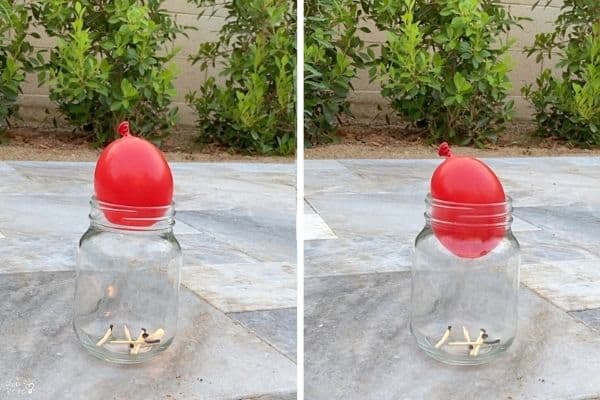
My kids had seen the egg-in-a-bottle experiment online and were begging me to try it. Basically, you take a hard-boiled egg, set it on the neck of a bottle, and then magically, the air pressure difference sucks the egg into the bottle.
The egg-in-the-bottle experiment sounded so fun! But for the life of me, I could not find a bottle that would work. The neck of a water bottle was way too small, and a mason jar was way too big.
Then it hit me: swap out the egg for a water balloon. Now you can use whatever mason jar you already have in your cabinet, because you just fill the balloon to match the opening.
This balloon in a jar air pressure experiment is one of the most dramatic “wait, HOW did that just happen?” moments we’ve ever had in our kitchen. My kids made me repeat it over a dozen times. Fair warning – you will too.
Ages: 5+ (adult-superfised) | Time: ~15 min | Mess Level: Minimal
What You’ll Need
- Water balloons
- Water
- Glass bottle or jar (any size – match your balloon to the opening)
- Matches or lighter – adult use only
- Optional: a permanent marker to decorate the balloon
How to Suck a Water Balloon into a Jar
1. Fill the water balloon with water until it’s slightly bigger than the neck of the bottle or jar (we used a Mason jar). Tie the balloon.
2. Set the jar on a flat surface. Place the water balloon on top of the opening – it should sit there without falling in.
3. Have your kids push down on the balloon to show that you cannot push it into the bottle.
4. Light a match and drop it into the jar.
5. Wait a moment for the fire to grow, then place the water balloon over the mouth of the jar.
6. Watch the fire go out and the balloon get sucked inside.
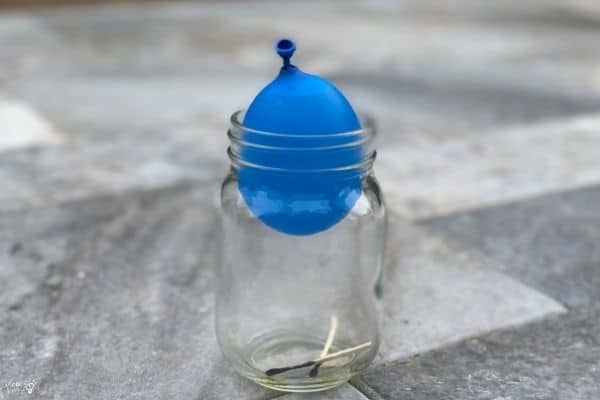
7. To remove the balloon, turn the jar sideways and slide a finger between the balloon and the jar rim to release the suction.
As with the cloud in a jar experiment, my kids loved watching me light the match (adults only, please!). Fire is always so exciting! Then they shrieked every time the water balloon bounced up and down because of the fire in the jar. We repeated this experiment a dozen times, and the kids were equally delighted each time!
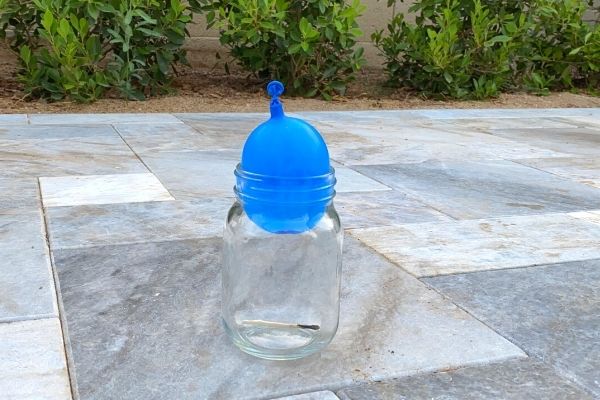
Troubleshooting: Tips for Getting the Whole Balloon In
We tried our hardest to get the entire water balloon in the jar. We tried water balloons of different sizes and dropping more than one lit match in the jar. There were a few times we got really close, but no cigar.
There are a few ways that I believe you could get the entire water balloon to fall into the jar, but we ran out of time (and sunlight):
- Use more matches. Five at a time creates a bigger flame and more heat. One reader confirmed this is the sweet spot.
- Try burning paper instead. A small piece of paper produces a larger, longer flame than a match, resulting in more heat and a greater pressure difference.
- Wet the outside of the balloon. A little water on the surface makes it more slippery and easier for the balloon to slide in.
- Use a slightly smaller balloon. If it’s way bigger than the jar opening, there’s more resistance. Try sizing down just a bit.
- Work quickly. Place the balloon over the jar while the flame is still strong. If you wait too long after lighting the match, the heat is already gone.
Even if it doesn’t go all the way in, the effect is still amazing, and kids will want to repeat it until they nail it.
Why Does the Balloon Get Sucked into the Jar?
When you drop a lit match into the jar, the heat causes the air inside to expand, and some escapes around the balloon. Once the oxygen is used up, the flame goes out, and the remaining air cools and contracts. This creates lower air pressure inside the jar than outside. The higher outside air pressure then pushes on the balloon – and since the balloon acts like a one-way valve (letting air out but not back in), it gets pushed right inside.
When you first try to push the balloon in by hand, it feels impossible. That’s because the air trapped inside the jar is already at the same pressure as the air outside. Neither side wins, so the balloon stays put.
The fire changes everything. It heats and expands that trapped air, forcing some of it to escape around the edges of the balloon – that’s the shaking and bouncing you’ll see. Then, when the flame goes out, the remaining air cools, contracts, and the pressure inside drops. The outside air rushes to equalize, but the balloon is blocking the way. So it pushes the balloon inward instead.
We saw the same air-pressure principle at work in our burning-candle-in-water experiment – a great one to try alongside this one.
Ghost in a Jar: Halloween Variation
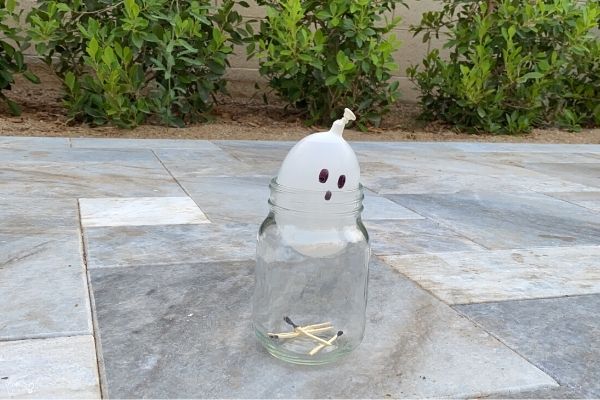
This one is ridiculously fun close to Halloween. Grab a white water balloon and draw a ghost face on it with a permanent marker before you fill it with water.
Show your kids (or a classroom full of them) how even the bravest push can’t force the ghost into the jar by hand. Then “magically” suck it in with the match. Cue the shrieks.
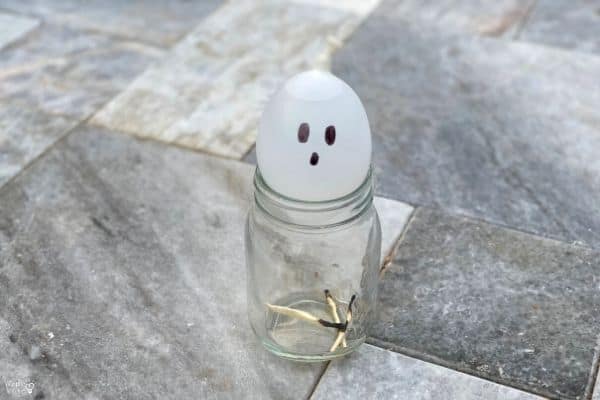
It also works as a Halloween party activity – set up a station where each kid decorates their own balloon, then watch all the little ghosts get sucked in one by one. The competitive spirit of whose went in farthest is half the fun.
More Air Pressure Experiments to Try Next
This experiment pairs really well with a few others that explore the same concept from different angles:
- Burning candle in water experiment – watch rising water demonstrate how heat and air pressure interact
- Hot and cold balloon experiment – see how temperature directly changes the size of a balloon
- Warm air rises and cold air sinks – connect air pressure to weather and wind
- Cloud in a jar – another jar experiment kids go absolutely wild for
Running a few of these in a row makes for a really satisfying air pressure unit. Kids start connecting the dots between experiments on their own, which is exactly the kind of thinking you want to encourage.
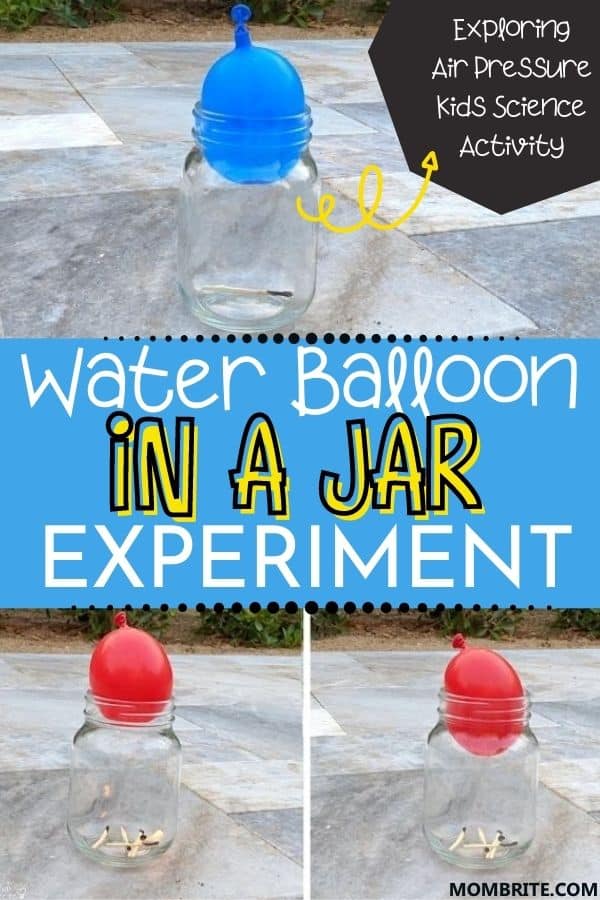
We did the Balloon in a Jar Air Pressure experiment today with our grandsons and it was great. We put eyes on the balloons like ghosts and we found that 5 matches worked best. They got to demonstrate for an aunt and their mom. All in all we did it about 10 times. It was a fun time. Thanks for the idea and the good instructions.
Great way to demonstrate this principle using a balloon! I love your posts, by the way. I do the experiment with the egg and I use a Starbucks frappuccino bottle that you can purchase at the grocery store. Just in case you want to try the egg version. The neck of that bottle seems to work well with most hard boiled eggs.