
Disclosure: This post contains affiliate links. I may earn a small commission at no extra cost to you. Learn more
Make a stunning 3D solar system with your kids using our rolling paint technique. Includes free styrofoam ball size chart + exact paint colors for all 8 planets.
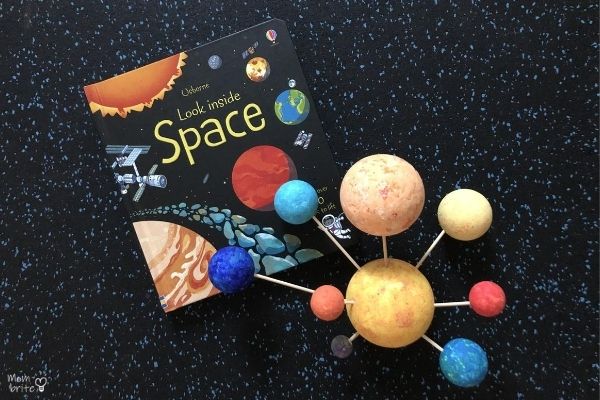
Your kid just came home with a science fair permission slip, or maybe their teacher assigned a solar system project due next week. Either way, you’re staring at it, wondering where to even start. Deep breath. This one’s actually fun, I promise.
Making a 3D solar system model sounds complicated, but it’s really just painting balls and sticking them on sticks. My kids and I finished ours in one afternoon, and they were so proud of it that it lived in our homeschool room for months.
Below you’ll find everything you need to make a DIY 3D solar system model: exact styrofoam ball sizes for each planet, paint colors that actually look right, and a step-by-step guide even preschoolers can follow. We used our favorite space book, Look Inside Space, to decide what each planet would look like in our model.
How to Make a 3D Solar System Model
Materials You’ll Need:
- Styrofoam balls
- 5″ or 6″ (Sun)
- 1″ (Mercury)
- 2 x 1.25″ (Venus and Mars)
- 1.5″ (Earth)
- 2 x 2″ (Uranus and Neptune)
- 3″ + foam ring (Saturn)
- 4″ (Jupiter)
- Acrylic paint
- Baking pan or tray
- White paper
- Tape
- Optional: skewer sticks
- Paintbrushes (for touch-ups)
Don’t want to hunt for individual balls? Grab a solar system foam ball kit that has everything pre-sorted. Heads up: the kit uses smaller balls than my list above (everything is proportionally scaled down), so the finished model is more compact. I prefer the bigger sizes for little hands, but if convenience wins? I get it.
The Rolling Paint Technique Instructions:
Here’s what makes this project different from most solar system tutorials: instead of carefully painting each planet by hand, we let the ball do the work.
1. Determine the styrofoam ball you will use for each planet and sun.
2. Place a piece of paper in the baking pan or tray. Tape the paper down so it doesn’t move around and slide when you move the baking pan or tray.
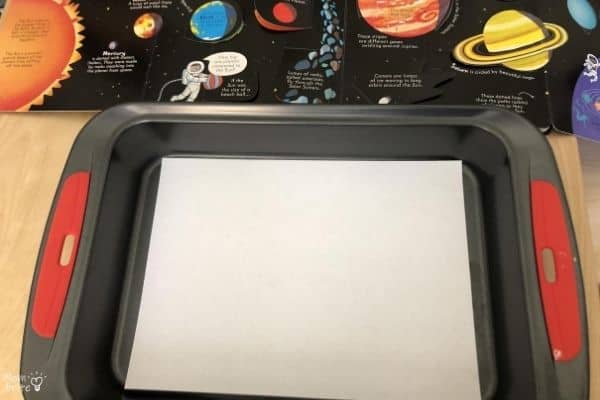
3. Pick a planet. Determine what colors you will use for the planet or sun.
4. Squeeze your paint colors onto the paper – not too much, just a few blobs.
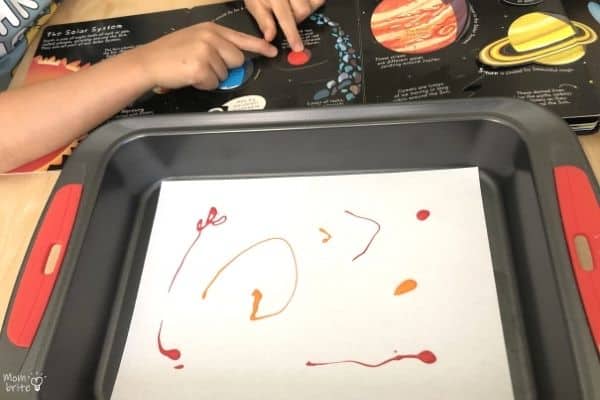
5. Drop the styrofoam ball in and tilt the pan back and forth. The ball rolls through the paint and covers itself!
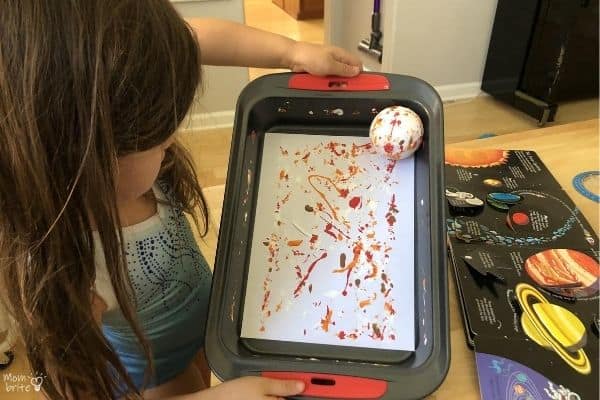
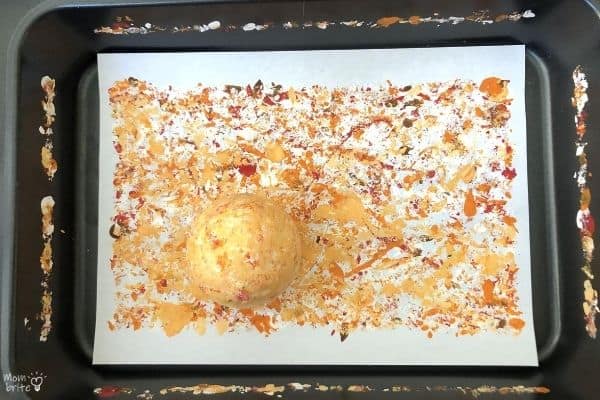
6. Keep rolling until the whole ball is coated. For smaller planets, you might need to nudge them with a paintbrush.
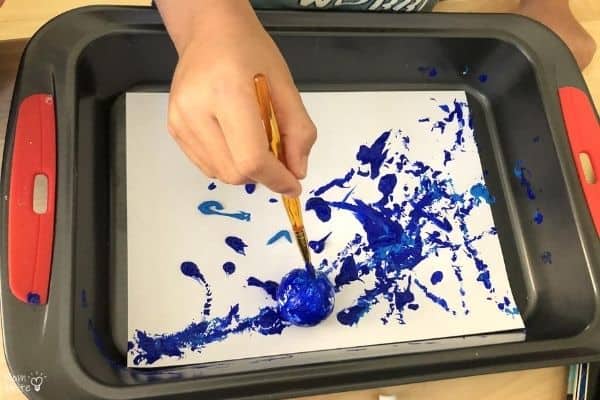
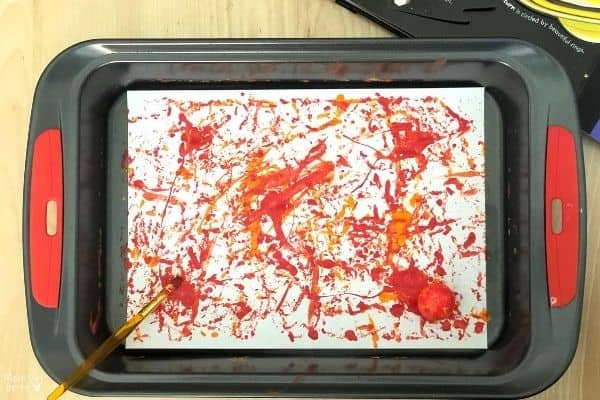
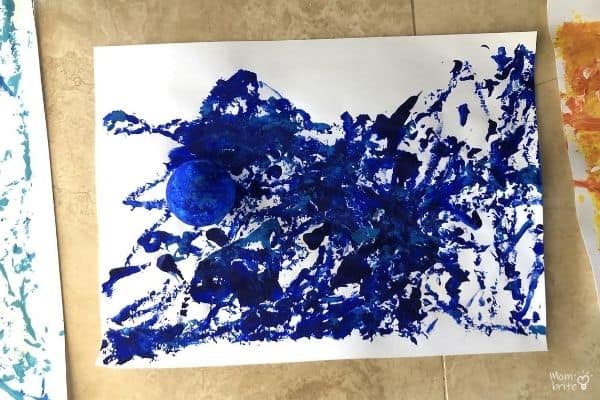
7. Repeat steps #3-#6 for all the planets and the sun.
8. Allow all the styrofoam balls to dry before playing with them.
9. Optional: Cut the skewer sticks in different lengths to represent the distance between the Sun and the planets. Carefully insert the sticks into the styrofoam balls. All the sticks should have a planet on one end and the Sun on the other.
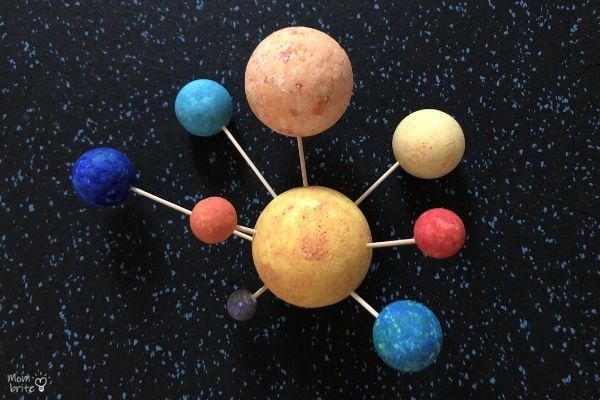
Not complicated, right? Since I have a preschooler and first-grader, I wasn’t about to ask them to make a 3D solar system by drawing all the details on each planet. By painting with a baking pan, we got the general idea of each planet, and you can definitely identify which one is which by looking at them.
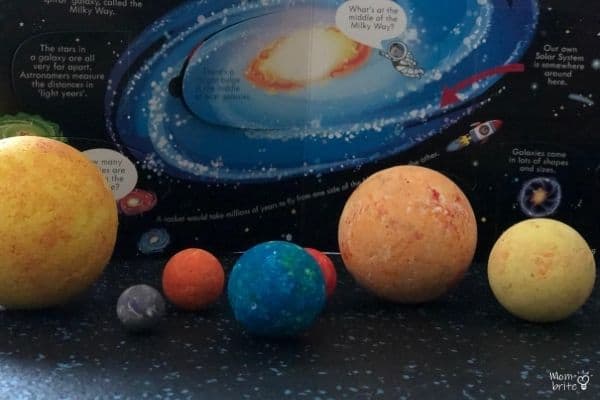
For each planet, my kids and I scrutinized Look Inside Space to determine which size styrofoam ball and what colors we should use. I believe this in-depth analysis of each planet’s surface helped my kids remember which planet is what much better than simply memorizing the names in a textbook.
I do have to point out that we did not make a ring for Saturn. There was no easy way to fashion a ring we could slip onto the planet and keep in place for the model. If you want to give it a go, you can try:
- Cut a ring from thin cardboard or craft foam
- Paint it gold or tan
- Slip it around Saturn before the paint fully dries so it sticks
Another option is wrapping a few rubber bands around the ball BEFORE rolling it in paint. This idea occurred to me after we already finished the model, so it was too late for us.
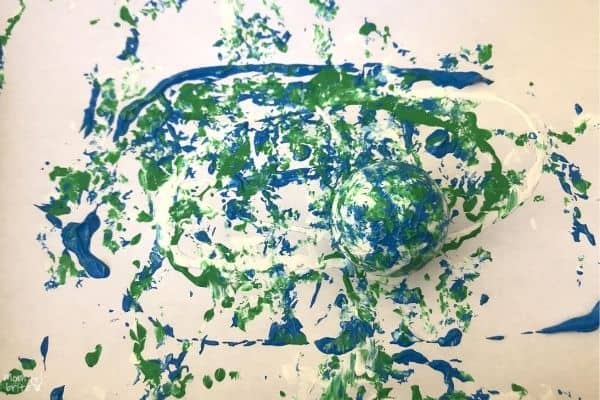
My kids loved making Earth. Because of the blue, green, and white color combination, they thought Earth was the prettiest planet. They also said that they loved Earth and would want to treat it well. How sweet!
While we were making the 3D solar system, we played The Planets by Holst. We discussed why Mars, the Bringer of War, sounded angry and almost like the Star Wars soundtrack. Our favorite was Jupiter, the Bringer of Jollity, because the song was lively and happy. The songs helped us memorize the planets not only visually but also aurally and emotionally.
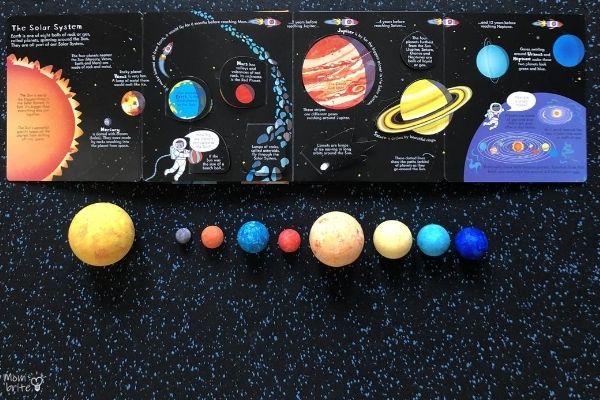
Before we stuck the planets onto the skewer sticks, my kids spent a lot of time playing with them. My first-grader placed the planets in order by matching them to the ones in Look Inside Space. Then he closed the book and tried to do it all by himself. He was able to do it after a couple of tries!
What Colors for Each Planet?
Getting the colors right makes a huge difference. Here’s what worked:
Mercury: Grey + purple + white
The closest planet to the Sun looks like our Moon – rocky and grey with hints of purple.
Venus: Red + yellow + white
Venus is covered in thick clouds that trap heat. The yellow-orange surface glows.
Earth: Light blue + white + green
Earth is mostly blue because about 70% of it is covered in water.
Mars: Red + orange
The Red Planet. Use way more red than orange.
Jupiter: Red + yellow + orange + white
The biggest planet has those famous stripes and the Great Red Spot. Don’t worry about getting the stripes perfect – the rolling technique creates a nice swirled effect.
Saturn: Yellow + white + brown
Mostly yellow with hints of gold and brown. For the rings, cut a foam ring or use thin cardboard painted gold.
Uranus: Aqua + light blue
A soft blue-green. It’s actually tilted sideways!
Neptune: Light blue + dark blue
The windiest planet. Deeper blue than Uranus.
Note that while some of the planets have similar colors, the colors in each planet has a different ratio. For example, we used a lot more red on Mars than Venus, and a lot more yellow on Saturn than Jupiter.
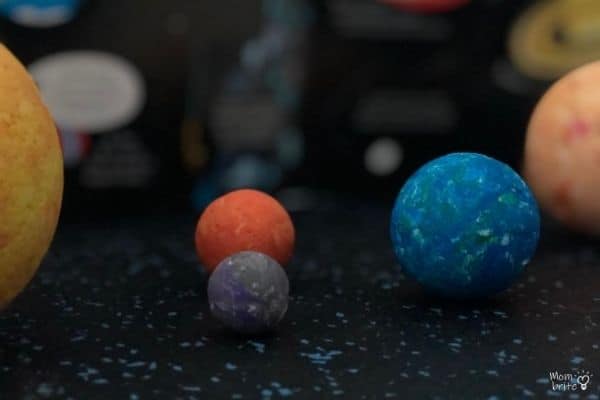
Display Options for the Solar System Model
Once your planets are dry, you have a few options for display:
Option 1: The Skewer Method (What We Did): Cut wooden skewers to different lengths – shortest for Mercury, longest for Neptune. Poke one end into each planet and the other end into the Sun. This shows how the planets orbit at different distances.
Option 2: Hanging Mobile: Thread fishing line through each ball and hang them from a coat hanger or embroidery hoop. Great for bedrooms!
Option 3: Poster Board Display: Glue the planets to a black poster board in order. Perfect for science fairs since it’s flat and easy to transport. Want stars? Dip an old toothbrush in white paint, run your thumb across the bristles, and let the splatter create a galaxy effect.
Option 4: Shoebox Diorama: Paint the inside of a shoebox black, add some star stickers, and arrange your planets inside. Kids love this one.
Download the Free Materials Kit

I put together a printable with:
- Styrofoam ball sizes for each planet (so you buy the right ones)
- Paint color reference for each planet
- Materials checklist to take to the store
- Space for your kid to plan their project
You can grab the free printable download by clicking on the image below:

More Space Activities
If your kids loved this, try:
- Oreo Cookie Moon Phases – Learn moon phases with cookies!
- Coffee Filter Planet Suncatchers – Beautiful window display
- DIY Moon Rock – Make your own space rocks
- LEGO Moon Phases Activity – Build the lunar cycle
- Aluminum Foil Moon Craft – Easy textured moon
I hope your solar system project turns out amazing. If your kids are anything like mine, they’ll be naming planets for weeks afterward. My son still calls Mars “the angry red one.”
Tag me @mombrite on Instagram if you make one – I’d love to see it!