
Disclosure: This post contains affiliate links. I may earn a small commission at no extra cost to you. Learn more
Build a balloon rocket that actually blasts off into the air! This easy DIY project teaches kids about rocket fins, stability, and aerodynamics.
When you purchase something online, it is typically shipped in bulk to make shipping cost-effective.
And that’s how we end up with 100 balloons.
So, in search of finding activities with balloons, the balloon rocket that shoots across the room often comes up. But we already did that one. My son then chimed in, “But shouldn’t rockets shoot upward?”
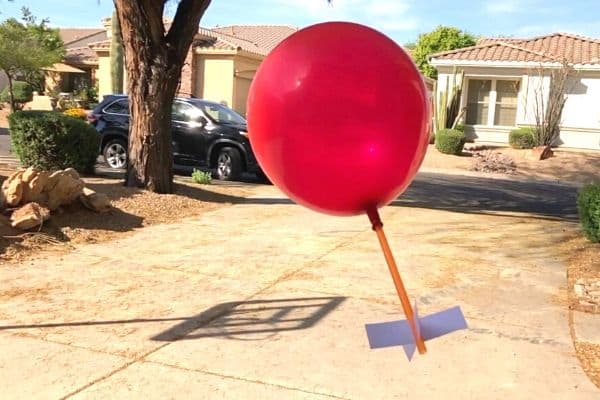
And that’s how we ended up building a balloon rocket that actually blasts off into the air!
This isn’t the classic string-and-straw experiment you’ve seen everywhere. This balloon rocket flies FREE – straight up, no track needed. The secret? Fins. Just like on a real rocket.
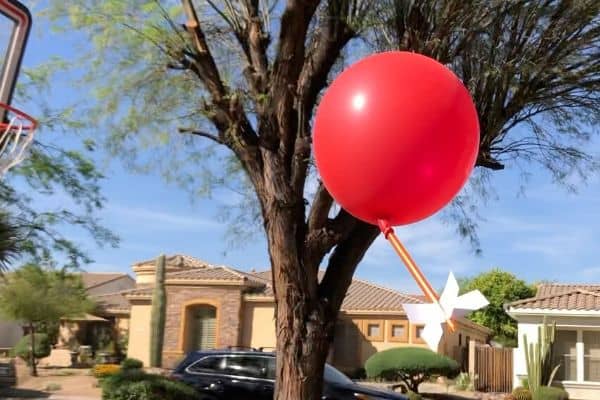
It’s super easy to build using things you have around the house. AND IT REALLY WORKS. We launched ours outside, and it reached the second floor of our house. My kids completely lost it.
Let me show you exactly how to build one.
What You Need to Build a Balloon Rocket
- A thick straw (I used a bubble tea straw – the wider opening lets more air escape for a bigger launch)
- Small rubber band (I used my daughter’s tiny hair elastics – they work perfectly)
- Balloon
- Cardstock paper
- Scissors
- Tape
How to Build Your Balloon Rocket (Step-by-Step)
Step 1: Attach the Balloon to the Straw
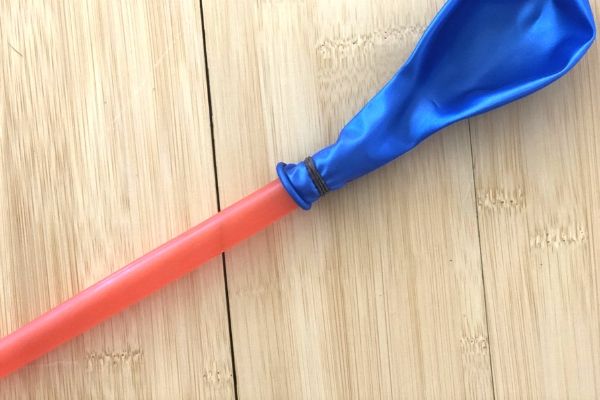
Place the balloon over the mouth of the straw. Fasten a rubber band around the balloon so that no air escapes when you blow into the straw.
I used my daughter’s hair elastics because they’re tiny and wrap tightly. If you use a bigger rubber band, you’ll need to loop it around several times to get a good seal.
No rubber bands? You can use tape instead. Just cut off the lip of the balloon first so you can tape it securely to the straw.
Step 2: Make the Rocket Fins
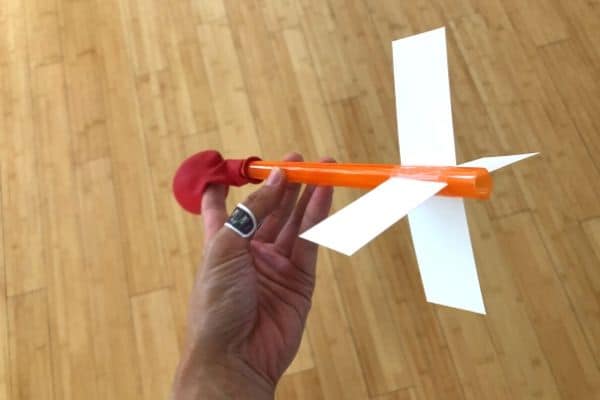
Cut 4 rectangles out of cardstock paper. Mine were about 2″ x 1.25″- but you really don’t need to be exact. Just make sure all 4 are roughly the same size.
These little rectangles are going to be your rocket’s fins, and they make ALL the difference. (More on that in a minute.)
Step 3: Attach the Fins
Tape the 4 rectangles to the bottom of your straw, evenly spaced around it. Think of a plus sign (+) when you look at it from the bottom.
Important: Leave a little room at the very bottom of the straw so you can still blow up the balloon.
Step 4: Inflate and Launch!
Blow up the balloon through the straw. You might need to press your fingers against the rubber band to hold the balloon in place while you blow.
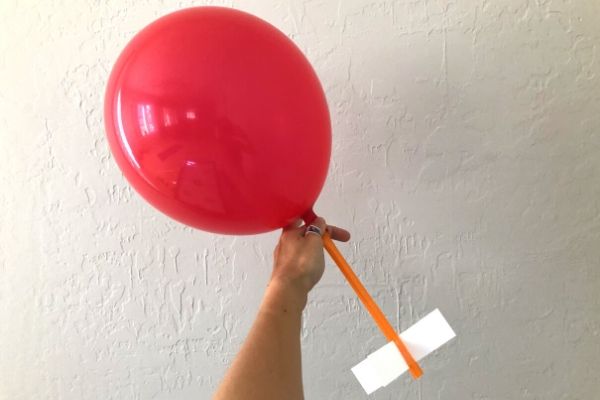
Once it’s inflated, hold your thumb over the straw opening to keep the air in.
Then:
- Hold the rocket vertical – fins pointing down, balloon on top.
- Count down: 3… 2… 1…
- Let go and watch the rocket blast off!
The Fin Engineering Challenge
Here’s what makes this project different from the classic balloon-on-a-string experiment. This one is really about engineering – specifically, how fins affect a rocket’s flight.
Why Do Rockets Need Fins?
Ever let go of a blown-up balloon without anything attached to it? It flies all over the place in crazy zigzags. That’s because the air escaping from the wobbly balloon opening pushes it in random directions.
Fins fix that problem.
When a rocket flies through the air, the fins “slice” through the air and keep the rocket pointed in one direction. Think of them like the feathers on an arrow; they create drag at the back of the rocket, which keeps the front pointing forward (or in our case, upward).
The right size, shape, and number of fins can make a huge difference in how high and straight your balloon rocket flies. Which is exactly why this is such a great engineering challenge for kids.
Test These Fin Variations
Don’t just build one rocket and call it a day! The real fun is testing different designs and seeing what happens. Try these:
No fins vs. fins: Launch the rocket once with no fins attached. Then add the fins and launch again. The difference is dramatic, and kids can see exactly why fins matter.
Small fins vs. big fins: Cut one set of tiny fins and one set of oversized fins. Which flies higher? (Spoiler: there’s a sweet spot. Too big and they create too much drag. Too small and they don’t stabilize enough.)
2 fins vs. 4 fins vs. 8 fins: Does more always mean better? Let the kids find out!
Different fin shapes: Try rectangles, triangles, and curved fins. Does the shape matter? Engineers at NASA and SpaceX test this exact thing with real rockets.
Fin placement: What happens if you put the fins near the top of the rocket instead of the bottom? (It won’t fly well at all – and figuring out why is a great learning moment.)
For each variation, have kids predict what they think will happen BEFORE they launch. Then test it. Were they right? This is real engineering: design, predict, test, and redesign.
What Real Rocket Fins Look Like
Here’s a cool thing to share with your kids: real rockets actually have surprisingly small fins. That’s because they’re traveling so fast that even tiny fins create enough force to keep the rocket stable.
Your balloon rocket moves much more slowly, so it needs bigger fins to stay on course. If your kids are into space, check out photos of a SpaceX Falcon 9 or a NASA SLS rocket and see if they can spot the fins. They’re tiny compared to the rocket’s body!
For more rocket projects, our 5 Easy Ways to Make a Rocket at Home covers everything from straw rockets to bottle rockets.
Troubleshooting Your Balloon Rocket
The rocket won’t fly straight: Your fins might be uneven. Check that all 4 are the same size and evenly spaced around the straw. If one fin is bigger or positioned differently, the rocket will veer off to one side.
The rocket doesn’t go high enough: Try blowing the balloon up more – more air means more thrust. Also, check that the straw opening isn’t partially blocked by the rubber band. You want maximum airflow when you release.
The balloon pops off the straw: Wrap the rubber band tighter, or add a second one. If you’re using tape instead, make sure you remove the balloon lip first for a flatter surface to tape against.
The fins keep falling off: Use more tape, or try a stronger tape like masking tape or duct tape. The launch creates a surprising amount of force, so flimsy connections won’t hold.
It works inside but barely flies outside: Wind is your enemy! Even a light breeze can knock a balloon rocket off course. Try launching on a calm day, or find a sheltered spot.
Take It Outside!
This balloon rocket works indoors, but the ceiling limits how high it can go. If you really want to see what your rocket can do, take it outside.
We launched ours in the backyard, and it flew past the second floor of our house. My kids were screaming. I was screaming. The neighbors were probably wondering what was happening.
Just one word of caution: don’t launch too close to the house. We almost got ours stuck on the roof! But hey, that just proves how well the fins work.
Balloon Rocket Build FAQ
What makes a balloon rocket fly straight?
The fins! Without fins, the air escaping from the wobbly balloon opening pushes the rocket in random directions. Fins create drag at the back, keeping the rocket pointed in one direction – just like feathers on an arrow or fins on a real rocket.
How high can a balloon rocket go?
With good fins and a fully inflated balloon, we’ve gotten ours past the second floor of our house (roughly 15-20 feet). Results depend on balloon size, fin design, and wind conditions.
Do you need fins on a balloon rocket?
Technically, no – the balloon will fly without them. But it’ll fly in wild, unpredictable zigzags instead of going up. The fins make this a real “rocket” rather than just a balloon flying chaotically.
What’s the difference between this and a balloon rocket on a string?
The balloon rocket experiment on a string uses a string track to keep the balloon moving in a straight line. That version is great for learning about Newton’s Third Law. THIS version flies free – no string – and teaches kids about aerodynamics and stability through the fins. Both are awesome, and they teach different science concepts!
What age is this project good for?
Ages 5 and up can build this with some help. The cutting and taping require decent fine motor skills. Younger kids (2-4) can help blow up the balloon and do the countdown – they’ll love watching the launch even if they can’t build it independently.
More Rocket Projects Your Kids Will Love
- Straw Rockets Activity – Blow-powered paper rockets with a free printable template
- Squeeze Bottle Rocket – Air pressure rocket with a free printable template
- Match Stick Rocket – Fire science experiment for older kids (adult supervision required!)
- Ghost Rockets – Alka Seltzer-powered rockets perfect for Halloween