
Disclosure: This post contains affiliate links. I may earn a small commission at no extra cost to you. Learn more
Learn how to build a LEGO marble maze that teaches kids engineering, problem-solving, and patience. Step-by-step instructions plus 9 creative maze challenges for every age!
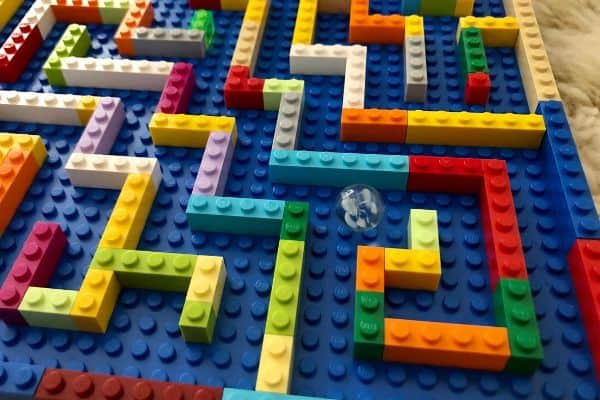
Marbles and LEGO blocks go together like peanut butter and jelly.
After we had so much fun building and playing with the LEGO Plinko board, my kids want another DIY LEGO toy that uses marbles. Hence, the LEGO marble maze was born.
The engineer in me was thrilled. Not only does a LEGO marble maze require kids to use their creativity to design their own paths and walls, but it also tests their fine motor skills as they tilt the baseplate to navigate the marble through tight corners and tricky dead ends.
And the best part? There’s no wrong way to build one. As long as the marble has a way to get from the entrance to the exit, your kid nailed it.
Whether your child is 4 or 12, a LEGO marble maze is one of those activities that keeps kids busy way longer than you’d expect. It’s screen-free, low-mess, and sneaks in a surprising amount of learning. We’re talking spatial reasoning, engineering design, and patience (so much patience).
Let’s build one!
What You Need to Build a LEGO Marble Maze
- LEGO baseplate – A 16×16 works great for beginners. A 32×32 gives more room for complex designs.
- LEGO bricks – You’ll mostly use 1×2, 1×4, 2×4, and 1×6 bricks for walls and paths. Grab whatever you’ve got.
- Marbles – Standard glass marbles work, but test yours first! Some are too wide for narrow paths.
- LEGO tiles (optional) – Flat tiles make the marble roll more smoothly, but studs work just fine too.
Quick tip: Before you start building, roll your marble across the baseplate to make sure it moves freely. Some larger marbles get stuck on the studs, and it’s better to find out now than after you’ve built an entire maze.
How to Build a LEGO Marble Maze Step by Step
Step 1: Build the Border
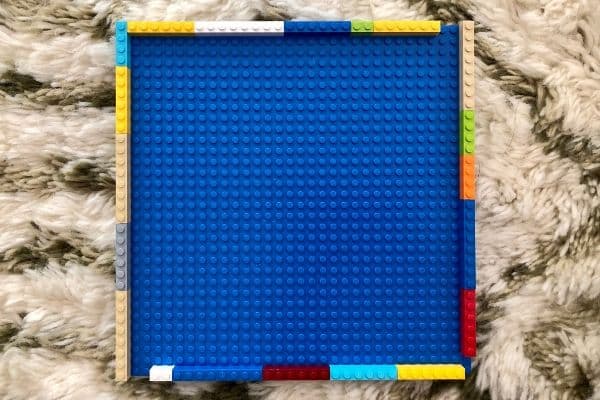
Start by building a wall of bricks all the way around the edge of your baseplate.
Leave two gaps – one for the entrance and one for the exit. I recommend placing them on opposite sides of the baseplate so the marble must travel through the entire maze to exit.
Make sure your marble can fit through the gaps before you keep building. Marble sizes vary, and there’s nothing worse than finishing an entire maze only to realize the marble won’t fit through the door.
Step 2: Plan Your Path
Here’s where the fun really starts.
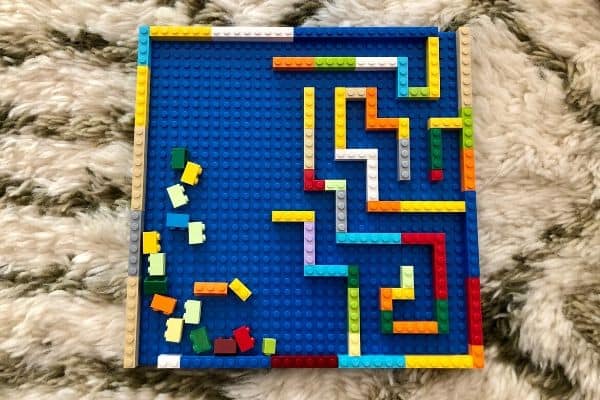
Before you start placing walls everywhere, think about the path you want the marble to take. You can sketch it out on paper first, or just wing it. Both approaches work.
If your kid needs a little inspiration, the Maze Generator website creates random maze designs that you can copy with your LEGO bricks. It’s a great starting point for kids who feel stuck.
The key is to create one main path from the entrance to the exit first. Once that’s working, you can go back and add dead ends and false paths to make it trickier.
Step 3: Build the Walls
Now start filling in your maze with walls and barriers.
A few things to keep in mind:
- Path width matters. Most standard marbles need paths that are at least 2 studs wide. Use your marble as a measuring tool as you build.
- Stagger your bricks. Just like real brickwork, overlapping the seams between bricks makes your walls sturdier. If you stack bricks directly on top of each other, they’ll pop apart when your kid tilts the baseplate.
- Mix up your brick sizes. Use longer bricks (1×6, 1×8) for straight walls and shorter ones (1×2, 1×3) for corners and tight spaces.
Don’t worry if your maze isn’t perfectly symmetrical or if some paths are wider than others. As long as the marble can roll through, it works.
Step 4: Add Dead Ends and False Paths
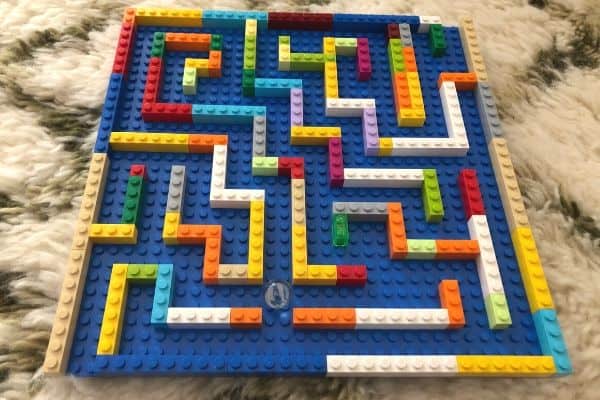
This is what turns a simple path into an actual maze.
Go back and add extra walls that create paths leading nowhere. These dead ends are what make the maze challenging to solve, especially if someone else is playing your maze for the first time.
Aim for at least 3-4 dead ends for a standard-sized maze. More for older kids who want a real challenge.
Step 5: Test and Adjust
Here’s the part that makes this a real engineering activity.
Put the marble in the entrance, tilt the baseplate, and see what happens. Does it get stuck? Is a corner too tight? Does it fly off the edge?
Every time something doesn’t work, it’s an opportunity to redesign and improve. This is what engineers do: build something, test it, identify what went wrong, and fix it.
My kids usually go through 3 or 4 rounds of testing before they’re happy with their maze. Testing and fixing are where the best learning happens!
LEGO Marble Maze Ideas for Every Age
One of the best things about this activity is how easily you can scale the difficulty up or down. Here’s how to match the maze to your kid.
Beginner Maze (Ages 4-5)
Keep it simple for little ones.
Build just one path from start to finish with no dead ends. Make the paths 3 studs wide instead of 2 so the marble has plenty of room. Keep the walls low – one brick high is plenty.
The goal here isn’t solving a tricky maze. It’s getting the marble from Point A to Point B without it flying off the board. That alone takes serious concentration for a preschooler.
Intermediate Maze (Ages 6-8)
Now we’re getting interesting.
Add multiple paths with several dead ends. Standard 2-stud-wide paths work great at this age. You can also introduce tunnels – just place a brick or plate across the top of a path section so the marble rolls under it.
This is the sweet spot where you can start adding challenges: time your kid and see how fast they can solve it, then see if they can beat their own record.
Advanced Maze (Ages 9+)
Time to get creative.
Build the walls higher and add bricks across the top to cover the entire maze. Now your kid can’t see the marble at all. They have to navigate entirely by feel and the sound of the marble rolling. (This is the “Blind Maze,” and it is SO hard. Even I struggled with it.)
You can also try multi-level mazes where the marble goes up a ramp and drops down to a lower level. Or build a maze with multiple marbles that all have to reach the exit.
For the ultimate challenge, have your kid design a maze specifically to stump a sibling or friend. Competitive maze building gets intense in our house.
9 Creative LEGO Marble Maze Challenges
Once your kids have the basic build down, try these challenges to keep things fresh:
1. The Blind Maze: Cover the top of the maze so you can’t see the marble inside. Navigate entirely by tilting and listening. This is harder than it sounds. Trust me.
2. Holiday Themed Mazes: Build a heart-shaped maze for Valentine’s Day. A pumpkin for Halloween. A Christmas tree for December. Change up the colors to match the season – red, white, and blue bricks for the 4th of July is always a hit.
3. Multi-Marble Madness: Put 3 marbles in the maze at once. Can you get all of them from start to finish without any falling out? It requires incredibly gentle tilting.
4. Speed Run: Time each family member solving the maze. Keep a running leaderboard on the fridge. Fair warning: this gets competitive fast.
5. Maze Swap: Each kid builds their own maze, then they trade and try to solve each other’s. This is great for playdates and LEGO clubs, too.
6. Color-Coded Paths: Use different colored bricks for different routes. Challenge: Can you get the marble to only follow the blue path? Only the red path?
7. Obstacle Course Maze: Place LEGO minifigures, trees, or animals inside the maze as obstacles the marble has to navigate around. Bonus points if your kid builds a little story around the obstacles.
8. Giant Maze: Got multiple baseplates? Connect them together for a mega-maze. You’ll need a friend to help hold it steady while you tilt.
9. The Impossible Maze: Design a maze that’s intentionally super difficult. Tiny paths, sharp turns, lots of dead ends. Then challenge the whole family to solve it. Whoever gets the marble to the exit first wins bragging rights.
Troubleshooting Your LEGO Marble Maze
Things not going perfectly? Totally normal. Here are the most common issues and how to fix them.
The Marble Gets Stuck
This usually means a path is too narrow. Most standard marbles need at least 2 studs of clearance. Pull out the marble, widen the path by moving a wall brick over, and try again.
Sharp corners can also trap marbles. If a 90-degree turn is giving you trouble, widen just the corner area to give the marble room to swing around.
Walls Keep Falling Off
Make sure you’re staggering your bricks by overlapping the seams between bricks on each layer. If bricks are stacked directly on top of each other, the connection is weak, and they’ll pop off when the baseplate gets tilted.
For extra stability, double up the bottom layer of your border wall.
The Marble Flies Out
Your walls might be too low. Stack another layer of bricks on top to increase the height.
Also, remind your kid to tilt gently. You don’t need much angle to get a marble rolling – a little tilt goes a long way. Slow, controlled movements win the race here.
My Kid Is Getting Frustrated
Start simpler. Pull out some of the dead ends and widen the paths. Let them test as they build rather than waiting until the whole maze is finished.
And remind them that real engineers test and fix things over and over. Getting stuck and figuring it out is part of the fun. Not getting it perfect the first time isn’t failing – it’s designing.
What Kids Learn from a LEGO Marble Maze
This is one of those activities that looks like pure play but packs in a ton of learning. Here’s what your kid is actually practicing:
Engineering design process. Plan, build, test, improve. They’re doing it over and over again without even realizing it.
Spatial reasoning. Visualizing paths, predicting where the marble will go, and understanding how moving one wall changes the whole maze layout.
Fine motor skills and hand-eye coordination. Tilting the baseplate just enough to move the marble without it flying out requires real precision. Great practice for younger kids, especially.
Patience and persistence. Getting a marble through a tricky maze takes focus and calm. My kids have learned more about patience from this activity than from anything I’ve ever told them.
Problem-solving. When the marble gets stuck, kids have to figure out why and come up with a fix. That’s critical thinking in action.
Love STEM challenges like this? Check out our LEGO Balance Scale for another hands-on engineering activity that uses bricks you already have!
Frequently Asked Questions
What size LEGO baseplate works best for a marble maze?
Both 16×16 and 32×32 baseplates work great. A smaller baseplate is better for younger kids because it’s easier to hold and tilt with little hands. A larger baseplate gives more room for complex designs and is better for older kids who want a real challenge.
What kind of marble works best?
Standard glass marbles work for most maze designs. Test your marble before you build too much – some glass marbles are a bit large for 2-stud-wide paths. Small steel ball bearings from a craft store roll the smoothest and tend to fit better in tight paths.
Can you use Duplo bricks for a marble maze?
You can, but you’ll need a larger marble or a smaller ball because the paths between Duplo bricks are wider. Standard LEGO bricks give you more flexibility for maze design, but Duplo works fine for toddlers who want to try a simplified version.
How long does it take to build a LEGO marble maze?
A simple beginner maze takes about 15-20 minutes. A more complex design with tunnels, dead ends, and multiple paths can easily keep kids busy for an hour or more. And then there’s the playing, testing, and redesigning – that can go on all afternoon.
Can multiple kids build a LEGO marble maze together?
Absolutely. One kid can design the path while the other builds the walls. Or each kid can build their own maze and then swap to solve each other’s. It’s a great collaborative activity for playdates, LEGO clubs, or classroom STEM time.
More LEGO STEM Fun
If your kids loved the LEGO marble maze, they’ll go crazy for these activities too:
- Balloon-Powered LEGO Car – Build a car, blow up a balloon, and watch it zoom.
- LEGO Zip Line – Build and test a working zip line for LEGO minifigures.
- Blow Pom Poms Through a LEGO Maze – A fun twist on the maze concept using pom poms and straws.
- Penny Boat Challenge with LEGO – How many pennies can your LEGO boat hold before it sinks?
Want even more LEGO STEM ideas? Grab the LEGO STEM Challenge Calendar – it’s packed with 30 days of creative builds your kids can do with bricks they already have!
Final Thoughts
I love “freestyle” LEGO activities like this, where you don’t have to follow an instruction manual to create something amazing. A LEGO marble maze sparks your kid’s imagination, builds real engineering skills, and gives them something to be genuinely proud of when they’re done.
Plus, the look on their face when they finally get the marble from start to finish on a tricky maze? Worth every scattered LEGO brick on the floor.
Happy building!
Thanks for the great idea. My kids are trying this tomororrow!
oops, “tomorrow”
haha I hope you have lots of fun!
Hello! Great idea! I appreciate your clear directions to help guide kids though the process of creating this maze. Just a note: the lego bricks have STUDS not stubs. There is Lego terminology that describe the different parts and kinds of bricks.
Thanks so much for your correction!
I tried this and is is so fun this made me so unbored tonight!🤩🩷