
Your kids will love this magic melting Skittles experiment. With just a few steps, your kids can watch Skittles dissolve in water and turn into a beautiful rainbow!
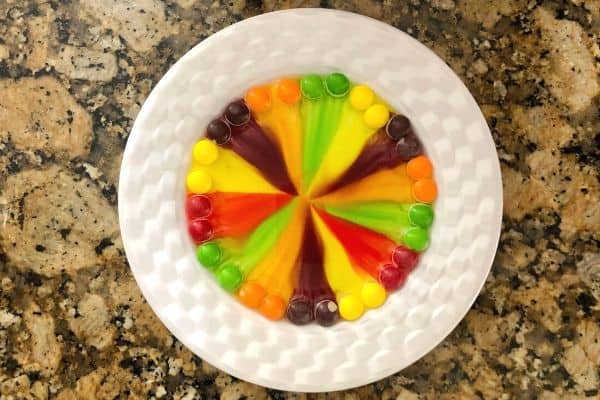
Skittles is famous for its “Taste the Rainbow!” campaign. The colorful candy shells on Skittles make them hard to resist.
Today, instead of tasting the rainbow, we are going to create the rainbow!
This Skittles rainbow experiment is one of the easiest activities for kids, and it has one of the coolest “magical” effects. If you have Skittles leftover from Halloween, Valentine’s Day, or Christmas, this is a must-do experiment.
How to Set Up the Skittles Science Experiment
Materials:
- Skittles (other coated candies work too)
- A plate (with a slightly raised edge to prevent the water from leaking out and to channel the water toward the middle of the plate)
- Water
Instructions:
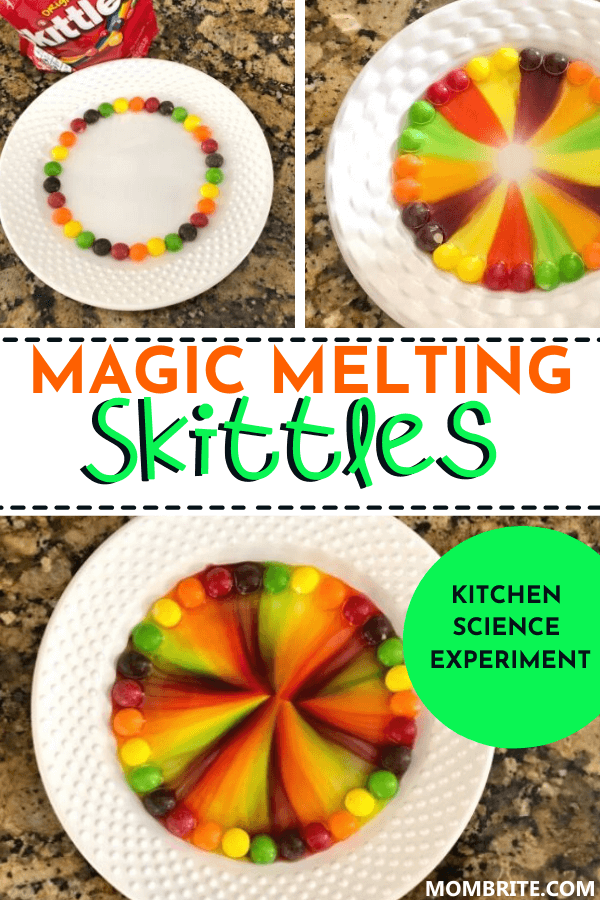
1. Place the Skittles in a circle around the edge of the plate. Use a repeating pattern of colors if you want a rainbow effect.
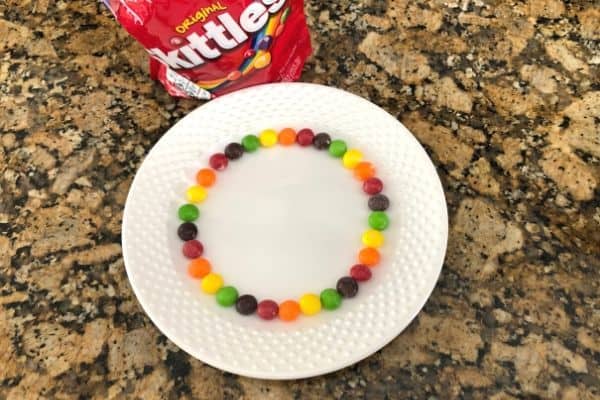
2. Slowly pour water into the center of the plate until it just covers the bottom of the Skittles. Do not touch the plate.
Watch the magic happen! Depending on the water temperature, the colors may dissolve almost immediately, or you might have to wait a little longer.
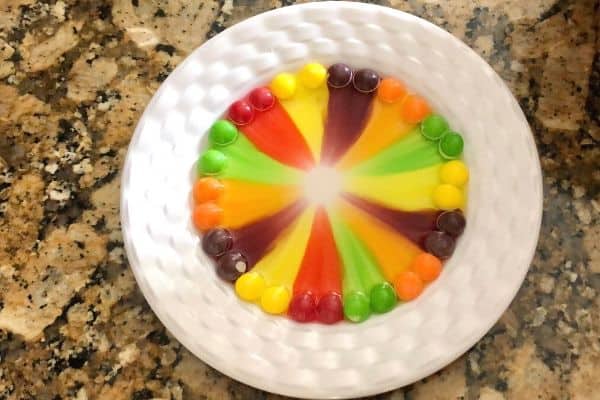
My kids loved watching all the colors slowly bleed into the middle of the plate. They asked to do this Skittles rainbow activity again and again.
Teaching Opportunities with the Skittles Experiment
Even though the Skittles science activity is as easy as it gets, there are lots of learning opportunities for your kids. You can:
- Ask your kid to announce the colors of the Skittles as he/she places them down on the plate.
- Arrange a few Skittles in a pattern and ask your child to follow the pattern to form the rest of the circle.
- Ask your child to count out loud as he/she places the Skittles on the plate.
- Ask your child to count how many Skittles of each color are on the plate.
- Use a fork and mix all the colors together – what color does it make?
Science Behind the Skittles Experiment
Skittles have a hard coating made out of food coloring and sugar. When the Skittles touch water, the coating dissolves and sends the food coloring outward.
The concept behind why the colors bleed to the center of the plate is called the concentration gradient. The concentration of sugar is higher near the Skittles than in the center of the plate, where there is only water. Therefore, the food coloring diffuses down a concentration gradient, from areas of higher sugar concentration to areas of lower concentration.
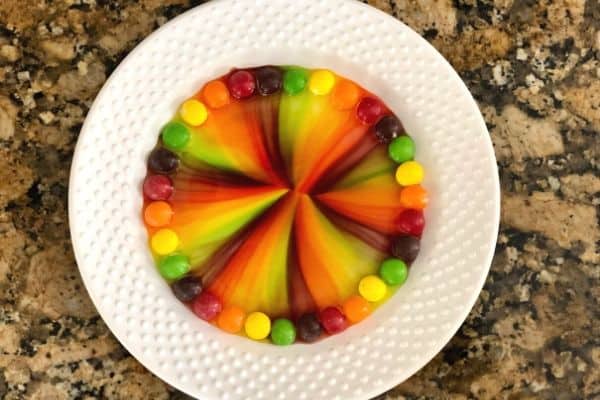
And as you can see, the diffusion stops when the concentration of the sugar is equal in all areas.
You might also observe that the Skittles colors don’t mix as they run toward the middle of the plate. This is due to water stratification, which occurs when the water has different properties such as density, temperature, salinity, and oxygenation.
The different-colored Skittles have slightly different chemical compositions. As a result, when they dissolve, the water has different properties, which prevents the water from mixing.
Science Extensions
Since this kids activity is easy to prepare and low budget, you can do it over and over again!
Try the following and see how the colors behave differently:
- Arrange the Skittles in a different shape.
- Arrange the Skittles randomly on the plate.
- Try using a different liquid, such as vinegar, salt water, or juice.
- Try using cold water, warm water, or hot water.
- Use another type of candy with sugar coating (such as M&M’s).
- After all the colors bled to the center of the plate, add a sugar cube in the center. Watch the colors run the other way!
I hope your kid thought the candy science experiment was as magical as my kids did! And I hope you have a big bag of Skittles because they will want to do this one over and over again.
YOU MAY LIKE:
Did you and your kids enjoy this activity? If so, you can buy me a coffee to support the materials necessary to conduct all the fun kids activities!
My class was so happy 😁😊
Aw I am so glad to hear that!