Disclosure: This post contains affiliate links. I may earn a small commission at no extra cost to you. Learn more
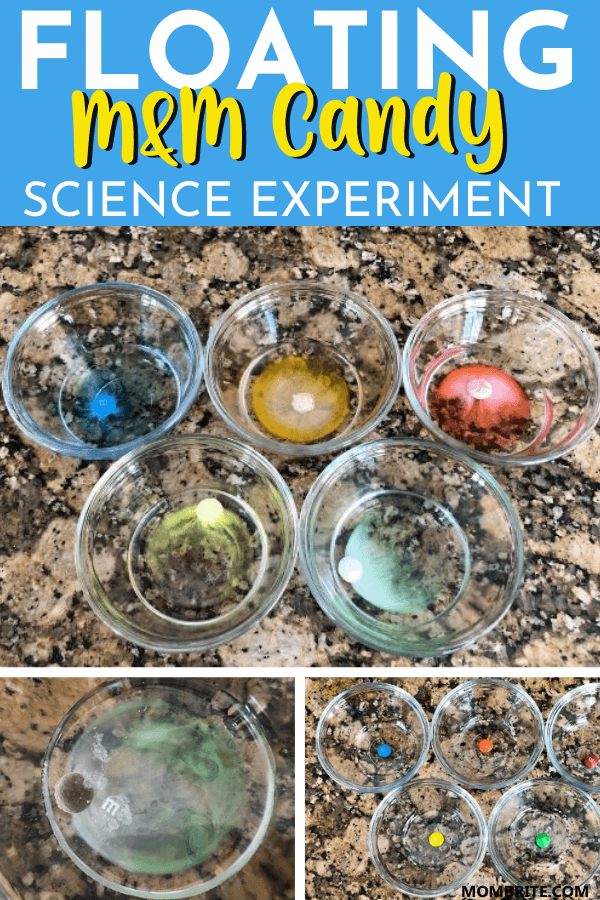
Watch M&M colors spread across the water as the white “m” floats away! This easy candy science experiment helps kids explore surface tension and dissolving.
We recently did the Skittles rainbow experiment, and my kids loved it. We don’t have candy in the house usually, so any candy experiment is super exciting since they do get to taste a couple – in the name of science, of course.
One thing that we noticed when the colors melted away was that the “S” from the Skittles floated to the top. However, the kids got excited and stirred up the colored water, breaking up the floating letters before I could point them out.
So today, we are repeating the Skittles experiment with M&M’s, except we are separating the colors into different containers to test which M&M color dissolves the fastest and which dissolves the slowest.
Yes, I did mean to arrange the glass bowls into the Olympic rings. The orange replaced the black ring since there are no black M&M’s in the bag.
How to Do the Floating M&M Candy Science Experiment
Materials:
- M&M’s party packs
- Water
- Small containers (such as these glass bowls)
Instructions:
1. Place one M&M of each color in its own container.
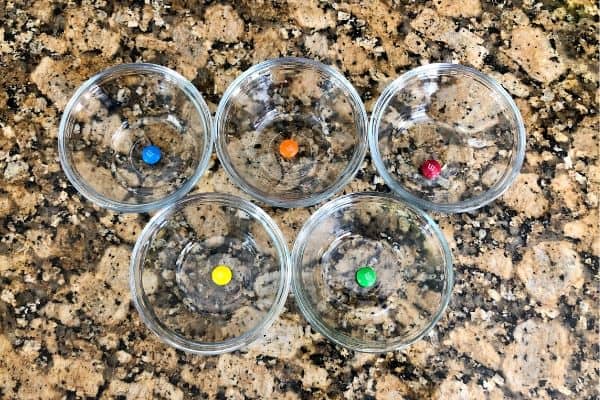
2. Slowly pour enough water into each container to cover the M&Ms.
3. Watch the colors dissolve off the M&Ms. Ask your child which color dissolves the fastest and slowest.
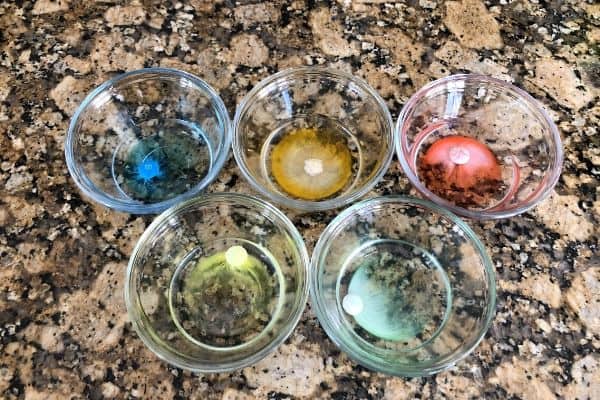
After the M&Ms sit in water for a bit, you’ll see the translucent shell and the letter “m” float to the surface of the water.
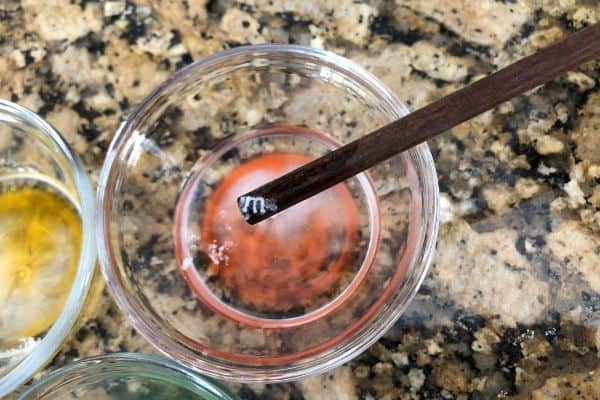
4. Use your finger or an eating utensil (I used a chopstick) to carefully lift the “m.”
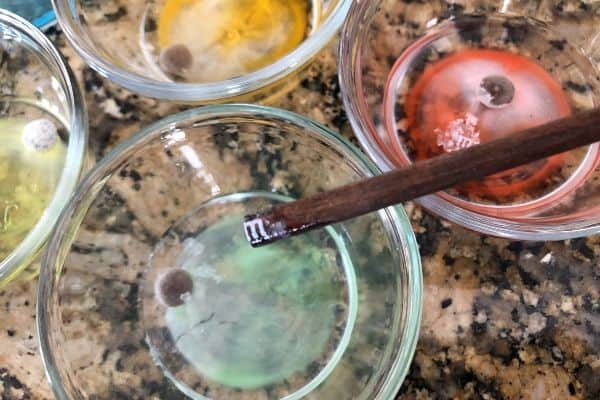
Isn’t it cool how you can separate the “m” from the chocolate? My kids really wanted to taste the “m” so I gave them each one. They said it didn’t taste like anything.
Did you notice that different colors dissolved at different rates?
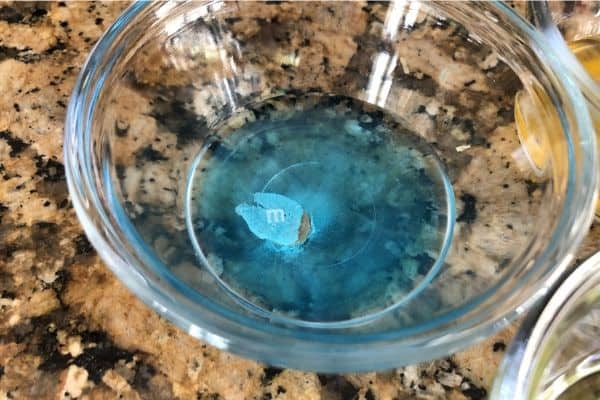
The red M&M dissolved the fastest, and the blue M&M dissolved the slowest. Even though all the colors dissolved from the red M&M, it took a few more minutes before the “m” separated from the chocolate and floated to the top.
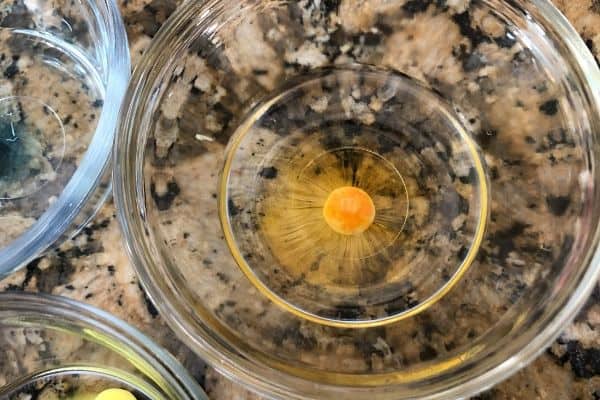
The green and orange M&Ms were a close second, but the “m” came off the orange one first. The color came off the yellow one slowly, but it took a long time before the “m” floated to the surface.
The blue one took about 30 minutes for the “m” to come off. You can see that the shells of red, green, and orange M&Ms had all dissolved, and the blue dye was still on the candy.
Why Do the M&M Colors Move and the “m” Float? (Science Explained)
When M&Ms are placed in water, several things happen at the same time.
First, the colored sugar shell begins to dissolve as soon as it touches the water. The sugar and food coloring slowly spread away from each M&M, creating the moving color lines.
At the same time, surface tension plays an important role. Water molecules like to stick together, forming an invisible “skin” on the surface of the water. This surface tension helps pull the dissolved color outward in smooth, straight paths and keeps the colors from mixing right away as long as the water stays still.
The white “m” on the candy behaves differently because it is printed with edible ink that dissolves more slowly than the candy shell. When the shell underneath melts away, the “m” separates and floats on top of the water for a short time. It’s very thin and light, so surface tension helps hold it up like a tiny raft.
Eventually, the surface tension breaks or the ink absorbs enough water, and the “m” sinks or disappears.
Science Extensions: Try These Simple Variations
Warm vs. Cold Water
Use warm water in one plate and cold water in another. The colors usually spread faster in warm water because surface tension is weaker.
Try Different Candies
Test different types of M&Ms, Skittles, or sugar-coated candies. Notice which colors spread fastest and whether the edible-ink letter floats each time.
Change the Spacing
Place candies close together on one plate and farther apart on another. Watch how the color patterns change when they meet.
Add Dish Soap
Add one small drop of dish soap to break surface tension. The colors will quickly mix and lose their shape.
Final Thoughts on the Floating M M&M Experiment
My son’s mind was blown when I told him that the Avengers picture on his birthday cake was also made out of edible paper, just like the letter “m.” He exclaimed, “How could paper taste so good!”
I love moments when you do a science experiment, and the result completely blows your child away.
What other candies should we play with next?
YOU MAY LIKE: